



In this blog, Maja and Debbie share their research project exploring whether a collaborative design process with a community in Mount Wise, Plymouth, can create opportunities for local people to do what they want to do. Debbie Freeman supports partnerships and community work at workers’ cooperative Zebra Collective, and Maja Luna Jorgensen is a design researcher at The Open University.
Our project background
Our partnership evolved through values alignment. Maja followed Zebra Collective’s work over a decade until she had the chance to meet the team and learn more. Zebra Collective is based in Devonport, Plymouth, a low income and stigmatised area where several members of Zebra also live. They do youth and community work, offer training in areas such as Trauma Informed Practice and Solution Focused practice, and improve access for local people to connect to nature.
We are both passionate about ensuring communities can do the things they want to do, which is also known as community agency. We decided to do a project together that would draw on our respective expertise, explore community agency, be useful to Zebra Collective, and benefit from Zebra’s deep connection and embeddedness in the area. In line with how Zebra works, the project would grow and benefit from relations with local people. So, we co-created a research project idea over several meetings and submitted the funding proposal in April 2024.
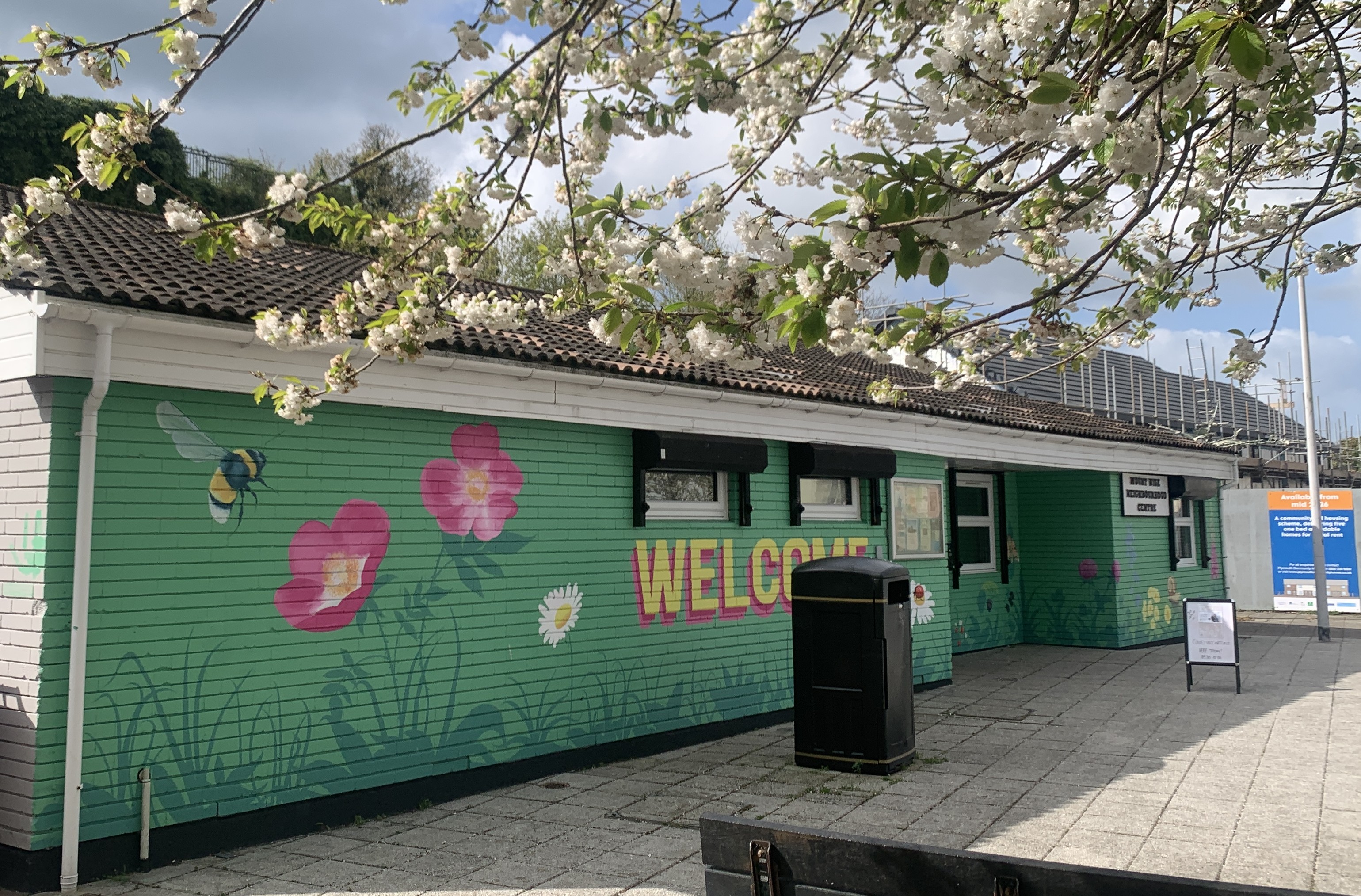
At the same time, Zebra took on Mount Wise Neighbourhood Centre, a much-loved but dilapidated local community building. Zebra see themselves as community stewards, bringing together the collective resource of the local community to improve the building and outdoor spaces. Their work includes a gardening group and nature-based activities at their youth clubs, joined by a ranger from Green Communities, a partnership project between Plymouth City Council and the National Trust.
In Summer 2025, Green Communities connected Zebra with Plymouth and South Devon Community Forest. Funded by UK Government, their aims are to plant trees and to make it easier for people to get to and use green spaces. They agreed to fund trees, hedges, plants and seating for the garden. Together with Zebra and The Open University, Green Communities and Plymouth and South Devon Community Forest formed the partnership for the garden transformation.
What we did
When the research project began in April 2025, we focused on a community-led co-design approach to improve outdoor spaces at the Neighbourhood Centre. This builds on Zebra Collective’s ongoing work to enhance the site and connect people with nature. The project would offer a space for local people to influence the direction and shape of their place and enable us to explore how such a process might affect people’s sense of agency, their ability to do what they want to do.
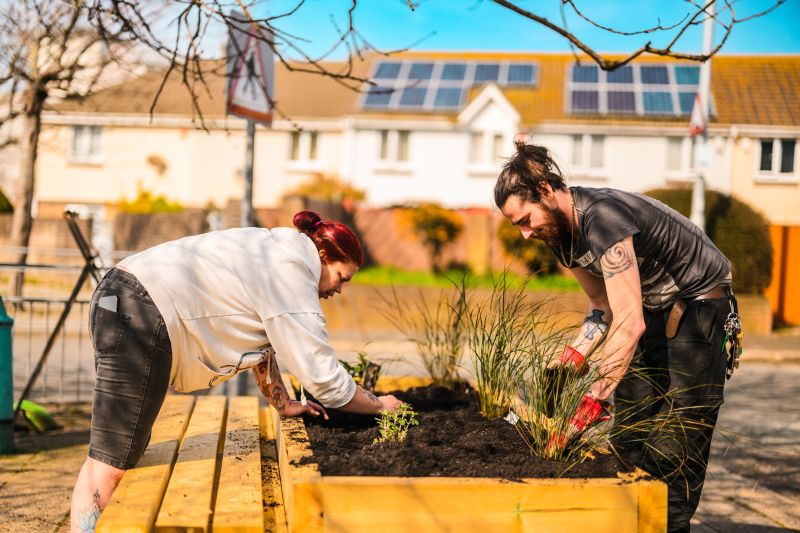
Two people lean over a large new wooden planter planting grassesand bedding plants into the soil, the man on the right is wearing work gloves.In the background is a blurred view of the street.
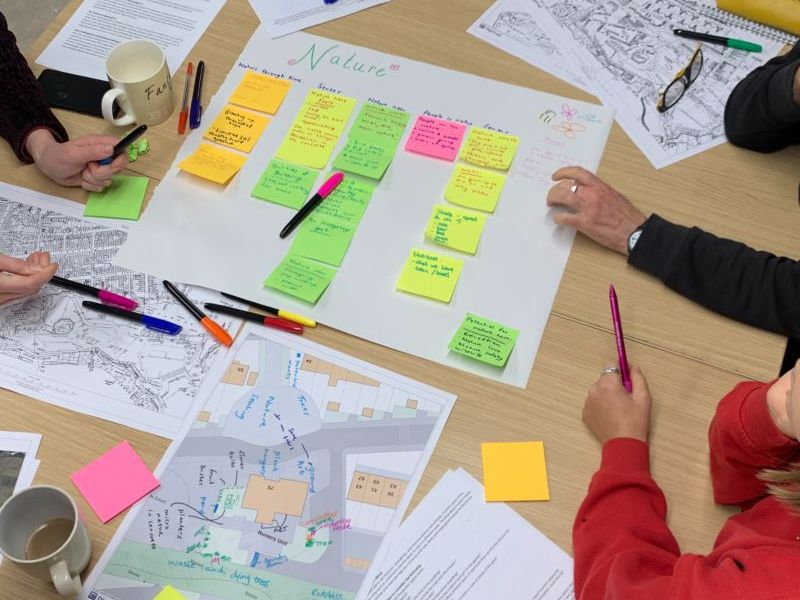
The co-design process with local people included several workshops and activities. People mapped their place to understand how it has changed and is currently used by people and nature, got ideas from young people at a youth club session, and visited another community-led greenspace to get ideas. They also learnt about key principles of shaping places and took part in a range of hands-on design activities.
The workshops were led by The Open University, with input from Zebra and supported throughout by local people, staff from Zebra, Green Communities, and Plymouth and South Devon Community Forest, who also funded workshop materials. We listened to what local people said about how they wanted to take part and used that to shape what we did together and when we did it.
Community ownership
We started working with the gardening group at Mount Wise Neighbourhood Centre, and other people gradually got involved in the workshops to share their views and ideas. Over several workshops, community members developed their ideas for the Centre’s garden using images and maps. This was made into a digital draft design by Plymouth and South Devon Community Forest and used for a public consultation, which led to a few more local people contributing their thoughts and ideas.
Local people continued to evolve the design during the weekly gardening group. Through ongoing conversations, the group observed the spaces around the Centre and used photos and maps to shape and finalise their design. Once decisions had been made, local people took part in the procurement process by choosing benches, planters, materials, and plants for the outdoor space in preparation for the Community Planting Day.
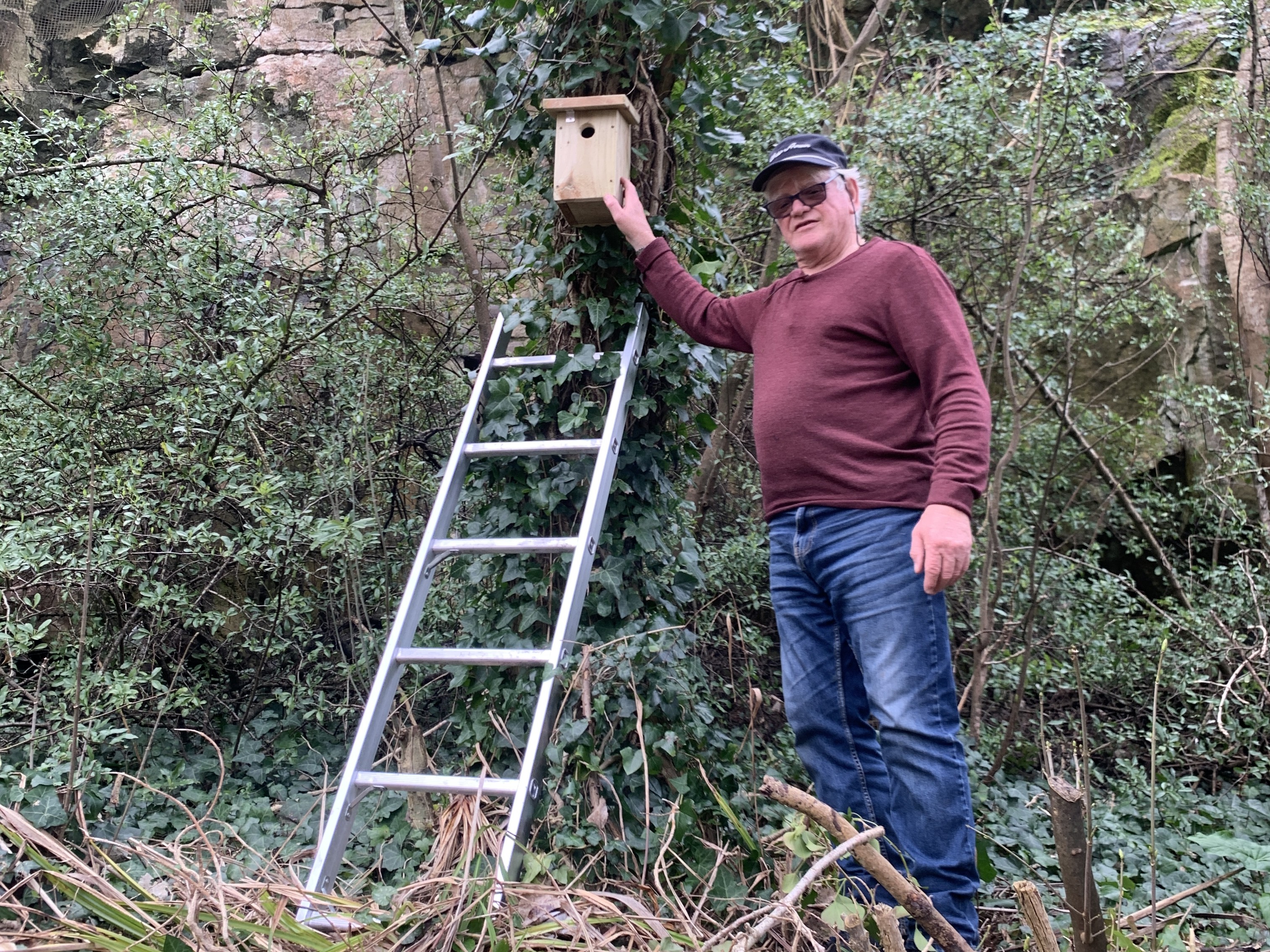
Local people who were involved in the co-design process also had the opportunity to lead ‘mini-projects’, focusing on things they each wanted to explore further. Mini-projects included working with an artist on a mural, selecting garden plants, thinking about how everyone would manage the garden, exploring the place’s history, and building bird boxes and bug hotels.
Around 100 people came to the Community Planting Day in March 2026 and built planters, a firepit and bird boxes, planted trees and plants, painted signs and a mural, moved soil and mulched trees. A ripple effects map was started to capture the journey of Zebra’s nature connection work, including this project.
The weekly gardening group continues to shape the garden to their design, alongside temporary support from Plymouth and South Devon Community Forest and ongoing support from Green Communities. Individuals are taking forward their mini-projects, and the group has started the seasonal cycle of planting seeds in their new beds. They are enjoying their new benches and the arrival of new local gardeners.
The benefits from taking part
I joined [the gardening group] because it was something else for me to get involved in within the centre and the more involvement I’ve had, the better my mental health and physical health has gotten. Our Garden is the heart of our centre, and we want to share it with everyone within our community, it will be a beautiful space that we can all use all year round. Outdoors in nature is the best medicine. - Gardening group participant Nikky Chapman
Both local people and partners involved in the project have recognised the value of this work taking place within Zebra’s ethos that sees local people and staff as equals. This has led to a strong sense of mutual ownership and of all contributions being perceived as equally valuable.
Local people do not regularly have the opportunity to engage with professionals as equals. During our project, community members were able to work alongside and learn from professionals in partner organisations, benefitting from knowledge and skills in nature conservation, ecology, placemaking, design, practical planning, communications, community engagement, etc.
Benefits to professionals included spending time with local people who generously shared their insights, skills, and knowledge. This in turned helped to build the professionals’ understanding of the place, community, and people, and what is needed to work successfully and equitably with a community.
Learning points
Agency: Local people are not ‘participants’ at the neighbourhood centre, they are the whole point - and the driving force - of what is happening: The ‘professional’ work is to hold a space that enables their ability to articulate what they want and to gently support it to happen.
Meeting as equals: During the research, Zebra began to articulate the benefit of minimising the distinction between 'staff' and 'community members'. In this collaboration it has supported the team’s ability to hold a space of and for co-creation.
Working relationally in place: It takes time and effort to be in a place, and to meet and get to know people – and it might also be enjoyable. The embedded nature of Zebra’s work longer term and of the researcher during the project has supported participation of people who wouldn’t otherwise have taken part and enabled a different level of involvement and contribution.
Partnership: The commitment and investment of project partners has made a real difference. All partners throughout the project contributed to all activities with available resources: time, relationships, funding, skills and knowledge.
Research funding: The funding secured was for career-development and didn’t include funding for the community partner. While the partnership agreed to seek additional funding, other Zebra funding priorities for the development of the building and community took priority. This led to Zebra Collective not being reimbursed for their time and a recalibration of how the collaboration would take place.
Next steps
As delivery in the project comes to an end, insights and learning from the project will be made available. The team will run knowledge sharing sessions from the project. For more information, please email Maja at maja.jorgensen@open.ac.uk.
The research project Radical Roots is a partnership between The Open University and Zebra Collective. It is delivered through Maja Jorgensen’s Innovation Scholar in Design secondment, funded by the Arts and Humanities Research Council (AHRC)/UKRI and hosted by The Open University's Design Group.
Image credits:
Heading photo by Brian Wangenheim on Unsplash
Community members planting a new raised bed by Chris Parkes.
Meeting notes
Other news you might be interested in

The transformative journey through Co-Production from the inside out
In this blog team member, Siobhan mentions her challenging lived experiences, describes her involvement in the Measuring Success Programme and explains what happens when we stop looking at life through the lens of our story and co-produce by simply being our authentic selves.

Co-creating arts-based tools with children for mental health and resilience
This blog discusses the Nkwihoreze project in Rwanda, where children and young people co-create culturally appropriate tools and resources to facilitate intergenerational dialogue and provide psychosocial support to families affected by the 1994 Genocide Against the Tutsi.

Diving in: Reflections on evaluating ourselves
With our eight Measuring Success in Co-production project teams onboard and their projects under way, members of the Measuring Success in Co-production co-ordinating team share their experiences of working together to evaluate their own co-production approaches.

Co-designing peer support resources for neurodivergent young people
In this blog Charlotte Webber shares what she sees as the difference between co-design and co-production from her experience of being involved in the Neurodivergent Peer Support Toolkit (NEST) project.
.jpeg)
Multicultural Co-production: the Amar Bari, Amar Jibon (My Home, My Life) partnership
In this blog the team behind the “Amar Bari Amar Jibon” (My Home, My Life) research study, share insights and reflections on how to do effective co-production in a multicultural context

Navigating Anti-Racism and Co-production: Our Journey and Reflections
In this blog Isaac Samuels shares their reflections from hearing the challenges faced by those from racialised backgrounds and global majority communities within co-production spaces.

Co-Production and Commissioning
Co-Production Collective Community member, and ex-staff team member Chloe talks about the role of co-production in commissioning from her experience of becoming a Commissioner.

Walking in your footsteps: Exploring co-production involving creative workshops
In this blog Briony Campbell shares her perspective on co-production as an artist/researcher who co-produces projects which involve creative workshops as well as some tips she has learned over the years.

What we have learnt from co-producing our Allies Group recruitment process
This blog discusses how we worked to make the recruitment process fair and open for everyone. It talks about what we did well, what we could do better next time, and how our efforts are helping to bring more diversity and engagement to the community.

How to best engage the public to participate in collaborative projects
Co-Production Collective co-producer Yesmin shares what she has learnt about how to best engage the public to participate in collaborative projects whatever form they take or whoever they are with