




In this blog, Chaeyeon shares her insights and experience from projects she's been involved with to co-develop research tools.
Chaeyeon Lim is the founder of DeBiasMe, a non-profit edtech start up and citizen science initiative across South Korea and the UK. She is an incoming doctoral researcher in human-computer interaction and designer advocating for community-led research and learning. You can contact her directly on info@debiasme.com or via Linkedin.
Categories, scales and forms we use as research tools
The field of human-computer interaction taught me to put people at the centre of research when designing technical solutions, but research about “users” usually measures whether the thing works and whether people liked it, rather than the harder question: who owned the decisions, and who was never in a position to make one. Co-design and co-production reach further back than that.
In co-production, people with lived experience and researchers share power and decisions across a whole project. I started DeBiasMe because I wanted to apply these methods alongside the diverse learning communities that research tools are rarely designed for: young people and people with different learning needs who might meet barriers in how a question is asked, and who often describe what matters to them in words no category list contains.
We spend a great deal of effort on who gets invited into research and very little on the research tool we hand people. Research tools include things like questionnaires, surveys and focus groups, and the categories used decide what kinds of thing exist, the scales (for example, a scale rating how much someone liked a feature from 0 – 10) decide how much of each is possible, and the form decides who can answer comfortably.
Tools that ask for vulnerability
Participatory research asks people for something researchers rarely have to give: an account of their own difficulty. This is usually collected through a form somebody else designed, so the first act of the relationship between a researcher and a participant is already unbalanced.
That is why the most common response to a co-production plan (“it sounds time-consuming and costly”) is worth a closer look. The alternative to co-production carries a cost too, since every questionnaire is a set of categories, scales and forms chosen elsewhere and earlier.
A research tool usually has to exist before funding is approved and before ethics permission is granted, and both of those come before anybody meets a participant. By the time the people who will answer it are in the room, the instrument is the one thing that cannot easily change.
And credit and reward often flow to outputs rather than to the process of building and employing the tools. Researchers can speak openly about publications, products and funding, while the people whose experience makes the work possible are expected to be motivated by contribution alone.
Designing through the tensions
We wanted to design a research tool that changed this. Asking people for vulnerability is only possible if the tool can actually capture what comes back, and that is where the design work begins. Building a tool together means facing uncertainties you cannot settle once and for all, because our work sits between competing demands.
We had to consider the following competing demands:
- Physical vs digital: A digital tool can travel, scale and keep a record, but it can lose the very experience it is trying to capture.
- Knowledge vs emotion: A knowledge-heavy tool treats an increase in understanding as the outcome, and other things (including the conditions that made the learning happen) as noise.
- Relational risks: Observing and formalising a relationship between people can change or damage it.
We work through these tensions with the people affected, rather than resolving them in advance and presenting the result. This is where citizen science has been most useful to me. It is a method in which members of the public gather and make sense of data alongside professional researchers, through collection, analysis and interpretation.
Sharing the whole research process means the person who records something is also there when it is sorted into categories, and there again when someone decides what it means.
Rebuilding the scale through consultation and co-design
Our first attempt at this was NatureNest, our project on children's eco-anxiety. It started as a consultation with Rudi Schmidt at the Horniman Museum and Gardens, alongside Lewisham Council's Right to Grow commitment.
Those conversations shaped the research tool we used in a co-design session, "Growing Data Together", held during London Data Week in 2025, which invited individuals, families and gardeners to share their experiences in their own way. We noticed that someone can be proud and anxious at the same time, for example about a seedling they are growing. If we had used a five-point scale to ask people about how they feel about climate concern, it would flatten those two feelings into one number that means very little.
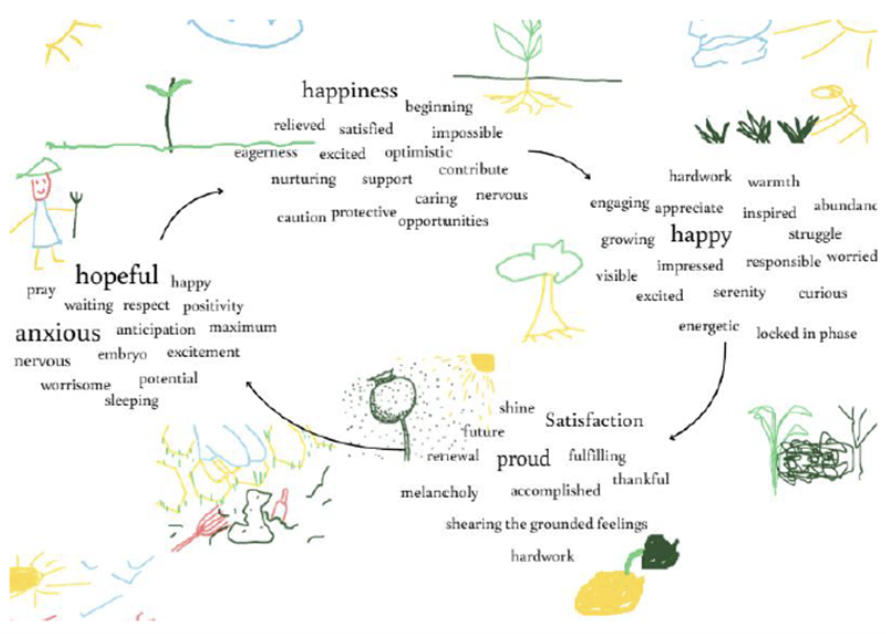
So rather than adapting an existing measure, we built our own survey instrument: emotion sliders in place of a single rating, open fields in place of fixed categories, and drawing in place of writing, so mixed and contradictory feelings could be recorded and expressed.
We shared the ongoing project at University College London's Festival of Digital Research, Innovation and Scholarship in 2025, where it received an honourable mention at the Open Science and Scholarship Awards.
Connecting the local and the universal
Alongside eco-anxiety, the other area we are also co-producing tools are related to AI bias because both can only be addressed when enough people can see it.
Here, much of our current work is about developing a research tool connected to learners, institutions, and the framework that decides what counts as AI harms and bias. Over the summer, supported by the Asan Nanum Foundation, we ran three successive workshops with 25 primary school students (8-14 years old) at Together Care Centre, a public after-school centre in South Korea.
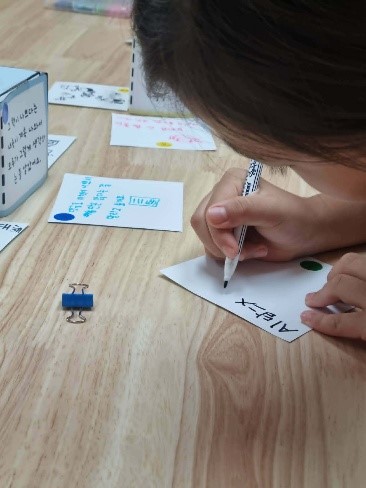
Each session was arranged so it could revise what the one before had produced, and together we redefined the pictures the toolkit uses and the way it works, aiming at a safe and collaborative environment in which children can share examples of bias they have seen in AI systems they have used and find ways to respond. One Year 6 pupil shared:
"At first I worried it might be hard, but it wasn't. I'm excited that my friends will learn more about AI because of something I helped make."
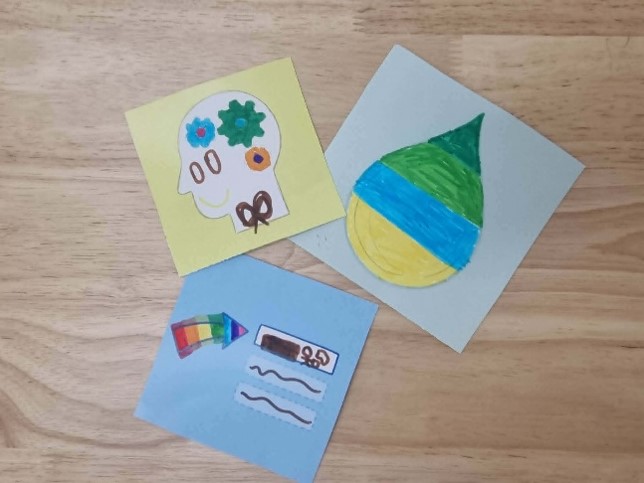
Alongside this, we support regional validation (a process in which educators and young people in one country review an international framework and feed back on whether its categories fit what they actually see locally) in South Korea for the UNESCO AI competency framework for students. A framework is a research tool too, and this campaign will continue to ensure that an international framework meets a range of local views, and those views are able to change the framework.
Towards co-production that redefines the problem
We are not all the way to co-production yet. What has changed is that our partner organisations now hold responsibility for the priorities and the framing, so the main question and the tools will keep being shaped between us.
This is why co-production is more than a better way to answer a question. Its real value, in our experience, is that it changes which question you were asking and how, and that shift usually begins with the tool. These are the questions we are working through together:
- Who built the research tool, and when?
- What can this tool not measure?
- Could a participant read their own answer back and recognise themselves in it?
Asking those questions honestly takes time that not every arrangement allows. Much participatory work is still run as a marketing exercise or a tick-box requirement, and the research tool tends to reveal it, because a form of that kind can record preferences but has nowhere to put an objection.
Building impact-driven partnerships
For nonprofit organisations and initiatives like DeBiasMe, participatory research is both the process and the outcome. That changes what we are willing to slow down for, and what our partners are willing to change when it does not work.
Most partnerships begin by finding the point where two organisations' separate interests happen to overlap. We try to do something slower: we build shared values with our partners over time. That ongoing relationship is itself a kind of infrastructure, as it is what makes it possible to rebuild standards and research tools together.
Building ladders that meet
If participation is a ladder, the ladder starts earlier than recruitment. It starts at the research tool itself: the categories, the scales and the forms that decide which answers are possible before anybody is in the room to object.
That starting point sits in a different place for every project, and usually in a blind spot. For us it was a survey and a toolkit. For another project, it may be the sign-up sheet or the online form written in language that suits the people who made it, or a framework whose categories arrive already translated.
DeBiasMe will keep looking for where and in what form our ladder should be built. We want to see that more ladders meet and hold each other to reach somewhere none of them could alone.
Heading image by Jan van der Wolf from Pexels
Meeting notes
Other news you might be interested in

December team update: Celebrating 2022
The latest news from the team and our community plus updates about our ongoing projects and upcoming opportunities.

Open to all: our Resource Library is now live!
After many years in the making we have launched our co-production Resource Library for all to use. Please explore and share widely!

Sparks of inspiration: our November team update
The latest news from the team and our community plus updates about our ongoing projects and upcoming opportunities.

Co-Production Collective Allies Group: September Meeting Notes
Co-Production Collective's Allies Group met once more to discuss key areas of our work. We're sharing the minutes so you can catch-up with what was discussed.

It’s October, time to celebrate our 2nd Birthday: Monthly team update
The latest news from the team and our community plus updates about our ongoing projects and upcoming opportunities.
Co-Production Collective Allies Group: July Meeting Notes
Co-Production Collective's Allies Group met once more to discuss key areas of our work. We're sharing the minutes so you can catch-up with what was discussed.

Autumn vibes: our monthly team update
The latest news from the team and our community plus updates about our ongoing projects and upcoming opportunities.

Continuing our journey to do more co-production: update on the 'Associate Roles' work
Catch up on the latest on our 'Associate roles' work, Vanessa who joined the team at the Collective recently to work on this project shares an update below

Ethical research: 'a state of being, not a state of doing'?
Lynn shares a personal, reflective account about developing guidance to help researchers and those seeking ethical approval for university linked work.

Going the extra mile in August: our monthly team update
The latest news from the team and our community plus updates about our ongoing projects and upcoming opportunities