


In this blog, Aurora, Chris and George share what went into co-producing our Co-Pro Cuppa on the theme of ‘payment and alternatives to payment’ as well as their reflections from the discussion that took place.
In March, community members Chris and Aurora and staff team members Asma and George met to co-produce a themed Co-Pro Cuppa on payment and alternatives to payment, a topic that comes up regularly in these sessions.
The team’s knowledge and expertise complemented each other really well:
- Aurora has a background in finance and governance and has a lot of experience of ensuring people with lived and living experience get paid for their contributions and the challenges this can bring up for both parties
- Chris has years of experience as a public contributor on a wide range of projects and knows the impact of organisations getting it right and wrong.
- Asma has a background in research and working in university settings.
- George has a background in the charity sector. So brought these experiences and their experience as Co-Production Collective staff team members to the discussion.
Considerations
The team all knew from experience that talking about payment and alternatives to payment can be quite a sensitive topic. People with lived or living experience may have personal experiences of trying to get paid or not being treated as they would have liked. Equally, people working for organisations can also find it really difficult to navigate the bureaucracy to ensure people with lived and living experience get paid and adequately compensated for what they provide.
That’s why it was really important for us as a team to find a way to set up a discussion about this topic in a way that everyone at the Cuppa felt comfortable and no one felt put on the spot.
What happened at the Cuppa
To do this, we decided to split people up into groups to have two discussions. The first would look at payment and alternatives to payment from an organisational perspective. The second to look at it from a lived or living experience perspective. Joining together after each discussion to share and reflect on what they said in their smaller groups.
To help set up these discussions Aurora shared some of her reflections from an organisational perspective and Chris shared a personal story of when an organisation got things right and went above and beyond what he expected.
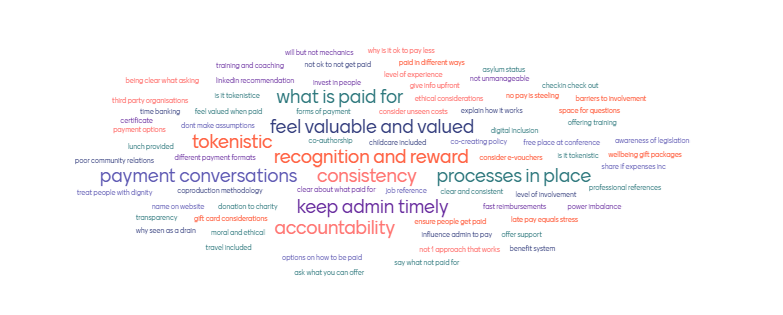
This seemed to work well for the 30 people that attended and there was a rich and varied discussion about the challenges organisations can face when paying people and how these can be overcome. As well as the importance of paying and rewarding people with lived and living experience in meaningful and non-tokenistic ways that work for them.
George’s reflections

What really struck me was the range of people who attended the Cuppa, that included people from very small charities to large institutions. As well as people with a wide range of experiences contributing to projects. All genuinely wanting to listen and learn from each other.
The discussion really highlighted from an organisational and lived experience perspective to me, the importance of discussing payment and alternatives to payment upfront to prevent issues further down the line. It also demonstrated the importance of training finance and admin teams about the key role people with lived and living experience play in projects. As well as why they may find standard procedures challenging, so need a more flexible and human approach.
I have sat in many Cuppas where people have asked about payment and benefits, and we have often shared our Co-Produced Payment Policy as well as NIHR guidelines etc to help people navigate this. To me this discussion was so much richer as it examined so many elements of payment and alternative to payment from a number of perspectives, highlighting the nuances and considerations to bear in mind for each area discussed.
Aurora’s reflections

From a project management and finance perspective, one of the recurring themes in co-production work is that there is often little dedicated time or infrastructure to properly consider the financial implications of involvement activities before they begin. While there is increasing recognition of the importance of meaningful co-production, many organisational systems — particularly finance, procurement, payroll, and governance processes — were not originally designed with flexibility and accessibility in mind.
This can create challenges for everyone involved. Project managers are often trying to balance inclusive and person-centred approaches with rigid organisational procedures, while finance teams are tasked with ensuring compliance, accountability, and consistency across systems that may not easily accommodate different forms of recognition, payment, or reimbursement.
The discussion highlighted that payment is rarely a straightforward transactional issue. For some people, direct payment may affect benefits or tax arrangements. For others, vouchers, honoraria, or alternative forms of recognition may feel more appropriate or accessible. At the same time, organisations themselves face practical challenges around processing payments, navigating employment status concerns, and managing the administrative burden associated with multiple approaches.
What emerged strongly from the session was that these are not simply operational barriers; they are deeply connected to the values underpinning co-production itself. Transparency, kindness, flexibility, and trust all play a role in how organisations approach recognition and reward. Standardised systems can provide important governance and fairness, but they do not always work for everyone equally well.
The conversation reinforced the importance of creating more open, honest, and conversational approaches around payment and alternatives to payment — approaches that acknowledge individual circumstances rather than expecting contributors to adapt to systems that may not have been built with their needs in mind. It also highlighted the value of organisations regularly reviewing their policies and practices to ensure they remain inclusive, practical, and aligned with the principles of co-production.
Chris’s reflections

Why does this issue come up repeatedly in spaces involving public contributors?
Irrespective of the wider acceptance of recognising their time and knowledge brought into a team, some aspects need our attention to think hard(er) about.
To begin with, recognition and first and foremost, financial compensation for public contributors are vital to ensure equity, foster genuine collaboration, and prevent the exploitation of lived experience. Monetary rewards often ensure involvement opportunities remain accessible rather than restricted to those who can afford to volunteer unpaid time and energy.
Without fair remuneration, involvement risks becoming an exclusive activity for those who can afford it. Financial recognition removes economic barriers, enabling participation from marginalised or systemically underrepresented groups who bring critical, diverse perspectives. This reality led the National Institute for Health and Research (NIHR) to draft specific guidelines and set national standards for organisations involving public contributors in health and care research.
However, this does not work for everyone, and flexibility is necessary to accommodate needs and preferences according to personal circumstances. There are cases whereas financial compensation may impact state welfare or disability benefits and it is advisable that public contributors be offered the choice to decline payment or request a lower amount.
Involvement requires time, effort, and sometimes logistical or childcare costs and organisations should be able to reimburse out of pocket expenses, when they occur, so that those in this situation are not financially disadvantaged by their willingness to take part in research activities.
Other payment alternatives include retail or electronic vouchers, which are regarded as highly effective for one-off sessions or when a contributor prefers not to disclose personal bank details. Making a donation instead of a payment is another example: Rather than paying individuals directly, funds can be donated to a specific patient charity, advocacy group, or community network that the contributor represents.
Finally, recognising public contributors’ input to the research output, be it in a report or a scientific paper, can be another example of recognition, listing their names alongside the names of academic researchers, and validating their contribution as a valuable source of knowledge.
Remember one size does not fit all and thinking outside the box is key.
Further information
We have included links to resources shared by Cuppa attendees below that you may find helpful.
Payment for Involvement - Jobcentre Toolkit
Payment for Involvement Playbook [Free Resource]
Co-Production Collective Payment Policy
Recognising and Rewarding Contributions in Public Involvement blog by Aurora Todisco
The Social Change – An organisation one attendee recommended that can do payment as a third party
E-vouchers – Company that offers a simpler way to pay people that was recommended by an attendee
You will also find other helpful information in our Resource Library. If there are any links you think we should add to this please email coproduction@ucl.ac.uk and let us know.
Header photo by Dorien Monnens on Unsplash
Meeting notes
Other news you might be interested in
Reflections from the ‘Payment and alternatives to payment’ themed Co-Pro Cuppa
In this blog, Aurora, Chris and George share what went into co-producing our Co-Pro Cuppa on the theme of ‘payment and alternatives to payment’ as well as their reflections from the discussion that took place.

Designing care that listens: why co-production matters in digital health
In this blog, Sindhu shares insights from her research and reflects on why co-production is key for digital health to benefit everyone.

Who does a play belong to? Co-producing 'Our Public House'
In this blog, Josephine Burton shares the power of co-production to give people a voice and shape arts projects.

Awakening to Anti-Racism: Growing Through the Tension
In this blog, we share a poem about anti-racism written by Isaac, a member of our community.

Beyond Silence: A journey through mental health and co-production
In this blog, Bolaji explores their experiences of co-production as a queer, non-binary person in Nigeria.

Navigating co-production: Katherine’s journey
In this blog we interview long-term community member, Katherine about her experiences of being involved in co-production for the last 17 years.

Strategic frameworks as practical tools for co-production
In this blog Aurora Todisco talks about the relevance of strategic frameworks for co-production and how they can be used to help evidence and progress projects.
.png)
Understanding Anti-Racism in Co-production Spaces: one year on
In this blog we reflect on how anti-racism has been integrated into how we work over the past year as well as our plans for the future.
.jpg)
How can we co-produce with senior leadership?
In this blog Sara Mae explores some of the challenges of embedding meaningful co-production when working within systems and the role of organisational leadership teams in improving work taking place in co-produced ways.

Our 2024 Community Survey and how we’re acting on its recommendations
In this blog we share the results of our 2024 Community Survey and what we have been doing since then to put your recommendations in place.