


.png)
This blog has been written by Afrodite Aggeli, Anna Giampoura, Chara Papantoni, Georgia Gagassouli, Odysseus Panagoiliopoulos, Thanasis Mitras and adapted in English by: Maria Tzortzaki (Project Coordinator).
When your child is diagnosed with cancer, the world changes overnight. Parents often describe those first days as stepping into a different universe — unfamiliar, frightening, and deeply isolating. In Greece, as in many countries, the psychosocial needs (including psychological support; family therapy; reintegration into school and community; social relationships with peer, friends and the wider community; support in managing financial burden of treatment, career impact of parents, emotional impact on siblings) of families navigating childhood and adolescent cancer often exceed what formal systems can offer. This gap widens after treatment ends, when families are expected to return to a “new normal”.
During psychoeducational sessions and caregiver support groups delivered by KARKINAKI — a non-profit organisation dedicated to advocacy, awareness, and psychosocial support for families affected by childhood and adolescent cancer in Greece — parents repeatedly highlighted the power of connecting with others who “knew what it’s like”. What became clear was that this shared understanding of being a parent of a child with cancer allowed them to be more open with other parents in ways that were often harder to express with healthcare professionals.
This idea of learning from one another is well documented in studies of families caring for children with chronic or life-threatening conditions. It is a form of peer support that involves the exchange of experiential knowledge, emotional reassurance, and practical guidance between people who have walked a similar path.
From these discussions — and informed by existing examples of peer support programmes in similar healthcare contexts — the idea emerged to create a dedicated space for these peer-to-peer exchanges between parents of children and teenagers with cancer: a space where parents at different stages of their child’s cancer journey could connect, speak openly, and support one another through key post-treatment transitions such as returning to school and work, rebuilding family relationships, and adjusting to everyday life after treatment.
Our programme co-ordinator, a mother of a young survivor with prior experience in co-production in the UK, guided this initiative. With shared commitment and purpose, we came together to co-design the first peer-to-peer support programme for parents of children with cancer in Greece.
This is our journey.
What we did – stepping into the unknown
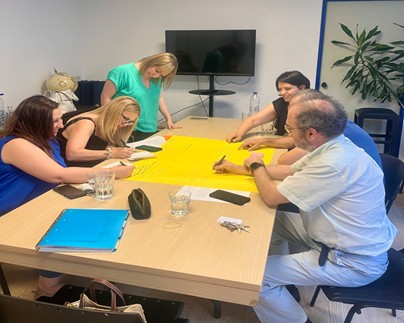
In early 2023, six parent volunteers — mothers, fathers, and a bereaved parent — came together, representing different cancer experiences, ages at diagnosis, and stages of survivorship. At first, many of us assumed the project coordinator would lead and we would simply “contribute”. But once we understood the principles of co-production, we realised we were being treated as equal partners — an idea that was both exciting and daunting.
Early in the process, we co-created a “Working Together Framework”, grounded in co-production values: sharing power, recognising lived experience as expertise, reciprocity, relational trust, and shared learning. This shaped not only how we collaborated, but also the pace of the work and our expectations of one another. Revisiting our children’s cancer journeys was different for each of us and, at times, emotionally challenging. We made sure to hold space for reflection, emotion, and look after each other throughout the process.
Together we:
- Reviewed existing guidelines and models for co-producing services as parents with lived experience of childhood and adolescence cancer
- Reviewed evidence on peer support programmes in healthcare settings
- Discussed unmet needs of families in Greece, drawing on our lived experience
- Defined what ethical, trauma-sensitive peer-to-peer support should look like
- Developed eligibility and matching criteria for Peer Mentors (parent volunteers further along the cancer journey who receive training and are matched with parents who need support) and participating parents
- Interviewed paediatric oncology and mental health experts
- Co-produced the Peer Mentor training programme and safeguarding protocols
- Created evaluation tools to measure Peer Mentor readiness, parent experience, and programme impact
For most of us, these were entirely new tasks. Our project coordinator helped us feel confident in reviewing peer-reviewed literature and introduced us to key concepts around ethics, safeguarding and programme evaluation. We were also guided by KARKINAKI’s scientific advisory team — a paediatric oncologist, a psychotherapist, and a social worker — who ensured our decisions were grounded in clinical and psychosocial best practice.
What co-production felt like
Although co-production was introduced to us as a methodology, in practice it became intuitive. There were moments of creativity and joy — brainstorming, mapping ideas, role-playing parent scenarios. At the same time, there were moments of quiet and discomfort when memories brought tears and silence. We learned to pause, support one another, and move forward.
At first, we thought we were “helping build a programme”. As the process unfolded, we realised we were actually shaping it — every decision, every discussion, every shared moment contributed to its foundation. Most importantly, we became a community long before Parent2Parent Support was launched.
“I came to help, but what I found here is also helping me.”
“Designing this programme gave my story a new meaning — it became something that it could help someone else.”
What we learned
We learned that co-production works — and its impact reaches far beyond the Parent2Parent Support programme.
Lesson 1
We never initially saw ourselves as experts — just as parents. Through co-producing the Parent2Parent Support programme, we learned that lived experience is expertise. This process helped us recognise the value of what we carry, not only emotionally, but also in terms of practical knowledge and insight. It felt natural that we all wanted to stay involved by training as Peer Mentors and supporting other parents navigating childhood and adolescent cancer. Working alongside healthcare and mental-health professionals as equals shifted dynamics and strengthened our confidence. We have always trusted the clinical teams caring for our children, but stepping into a leadership role alongside them gave us the skills and confidence to advocate, collaborate, and contribute with a new sense of purpose.
Lesson 2
Co-production is neither easy or fast. We faced challenges balancing workshops with work, caregiving, and everyday responsibilities. Flexibility made a huge difference — choosing meeting times together, and having resources, workshop material, and timelines shared online and in advance allowed us to participate at our own pace. Being supported by KARKINAKI and the project coordinator throughout the process mattered, especially as we all came from different professional backgrounds. Our “Working Together Framework” created safety, and clear boundaries. Having shared expectations, and a sense of structure has also informed the way we operate as Peer Mentors - monthly supervision sessions are key in helping us feel supported in our new roles. We now understand better than ever, that selfcare is essential for sustainable peer-to-peer support.
Lesson 3
Through our research and conversations, we realised that certain voices are often over-represented in peer support initiatives. We are grateful for the diverse perspectives within our group — including two fathers and a bereaved parent — whose contributions shaped our understanding of grief, healing, gender, vulnerability, and community. The presence of fathers also helped highlight the value of seeking psychological support, something often less visible for men in caregiving roles. Still, we know there is more to do. Families from lower socio-economic backgrounds and those living in remote parts of Greece face additional barriers to accessing support. Their needs must continue to guide the next phases of this programme, and ensuring their voices are represented remains a priority
“Our lived experience finds new purpose — it creates trust, and turns a painful journey into something that can help another parent feel less alone.”
“I wanted to expand my knowledge in peer support and mentoring, and I feel truly excited about what I’m able to offer to Parent2Parent as Peer Mentor.”
Looking ahead
Co-producing Parent2Parent Support reminded us that families do not heal in isolation — they heal in connection. Our ambition moving forward is to offer Parent2Parent Support to families from the point of diagnosis and to develop a digital learning toolkit for Peer Mentors. We also want to expand the reach of the programme further, so that every parent in Greece affected by childhood and adolescent cancer can access peer support.
This is our co-produced vision
"We want to support every family experiencing childhood and adolescent cancer."
This work is ongoing and imperfect. We are still learning. - In fact, this month we are navigating the complexities of welcoming new Peer Mentors into our team - a reminder that growth requires patience, space and continuous reflection. We look forward to walking alongside our community - learning, sharing and building support systems that start with the voices of those who “know what it’s like”.
Headline photo credit: Phot by Immo Wegmann from Unsplash
Meeting notes
Other news you might be interested in

Going the extra mile in August: our monthly team update
The latest news from the team and our community plus updates about our ongoing projects and upcoming opportunities

Why Co-production, and why the Collective?
Our team is changing! We are introducing two new staff members, and as Rory is leaving her role as Project Co-ordinator, she shares key moments from the past two and half years.

Many reasons to rejoice in July: team update
Catch up on all the activities and opportunities that July holds, including updates from our team.

Co-Production Collective Allies Group: April Meeting Notes
The Co-Production Collective's Allies Group met once more to discuss key areas of our work. We're sharing the minutes so you can catch-up with what was discussed.

Showing our colours in June: monthly team update
We're sharing news about our team plus updates about our ongoing projects and upcoming events.

UCL’s Strategic Plan Consultation: Our Response
Read the Co-Production Collective’s community’s response to UCL’s proposed strategic plan

A chance of change in April: Monthly Team Update
Find out what our team is up to this month and hear about new opportunities to get involved in this spring!

Shining bright in March: monthly team update
We're spreading the co-production sunshine this month - find out what we're up to and share your ideas.

Co-Production Collective's commitment to inclusivity at UCL
We share our response to UCL’s decision not to re-join Stonewall’s diversity schemes supporting LGBTQ+ inclusion.
Co-Production Collective Allies Group: January Meeting Notes
In January 2022, our Allies Group met to discuss key issues about the Collective and the meeting notes are now available to read.